Deinonychus antirrhopus
Discover the size, physical characteristics, hunting abilities, fossil discoveries, diet and fascinating facts about Deinonychus, one of the most remarkable raptor dinosaurs
Deinonychus was a medium-sized carnivorous dinosaur that lived in North America during the Early Cretaceous Period, approximately 115–108 million years ago. Its name means “terrible claw”, referring to the large, curved claw on the second toe of each hind foot. It measured approximately 3.4 metres in length and weighed around 100 kilograms. Unlike much larger theropods such as Tyrannosaurus rex, Deinonychus had a relatively lightweight body, powerful hind legs and a long, stiff tail. These features helped it maintain balance while running, turning and pursuing prey. It belonged to the dromaeosaurid family, a group of predatory dinosaurs that also included the well-known Velociraptor. Despite its relatively modest size, Deinonychus was an effective hunter equipped with several specialised physical adaptations.
One of the most distinctive features of Deinonychus was the enormous sickle-shaped claw on the second toe of each foot. This claw was held above the ground while walking, preventing it from becoming worn or damaged. Scientists have proposed several possible uses for this specialised weapon, including gripping, pinning and restraining prey. Its feet also had smaller claws on the remaining toes, while each hand possessed three long, clawed fingers that could help it grasp objects and capture animals. Deinonychus had a relatively large skull containing sharp, backward-curving teeth suited to tearing flesh. Another important adaptation was its elongated tail, reinforced by bony tendons that restricted excessive movement and provided stability. Although no direct fossil evidence has confirmed feathers on Deinonychus itself, closely related dromaeosaurids have preserved feathers, making it highly likely that this dinosaur also had a feathered covering.
The earliest known Deinonychus fossils were collected in Montana, USA, during an expedition led by palaeontologist Barnum Brown in 1931. However, the significance of these remains was not fully understood until John Ostrom and his team discovered additional specimens in 1964. In 1969, Ostrom formally described and named the species Deinonychus antirrhopus. His detailed examination revealed several anatomical similarities between Deinonychus and modern birds, particularly in their skeletal structures and limbs. These findings challenged the traditional image of dinosaurs as slow, sluggish reptiles and helped establish a new understanding of dinosaur biology. This major shift in palaeontological thinking became known as the Dinosaur Renaissance, transforming scientific research into dinosaur evolution and behaviour.
Deinonychus inhabited the ancient floodplains and woodland environments of North America, sharing its habitat with various prehistoric animals, including the large plant-eating dinosaur Tenontosaurus. Fossils of these two dinosaurs have been discovered together, suggesting a possible predator-prey relationship. These associations originally led Ostrom to propose that Deinonychus hunted cooperatively in groups to overpower larger animals. However, this interpretation remains debated, as fossil associations do not necessarily prove coordinated pack hunting. Some researchers suggest that individuals may have gathered around the same carcass rather than hunting together. Its diet probably included smaller animals and herbivorous dinosaurs. Deinonychus also became widely recognised through popular culture because its appearance and anatomy inspired the fictional Velociraptors portrayed in the Jurassic Park films, although the movie creatures were considerably larger than real Velociraptor specimens.
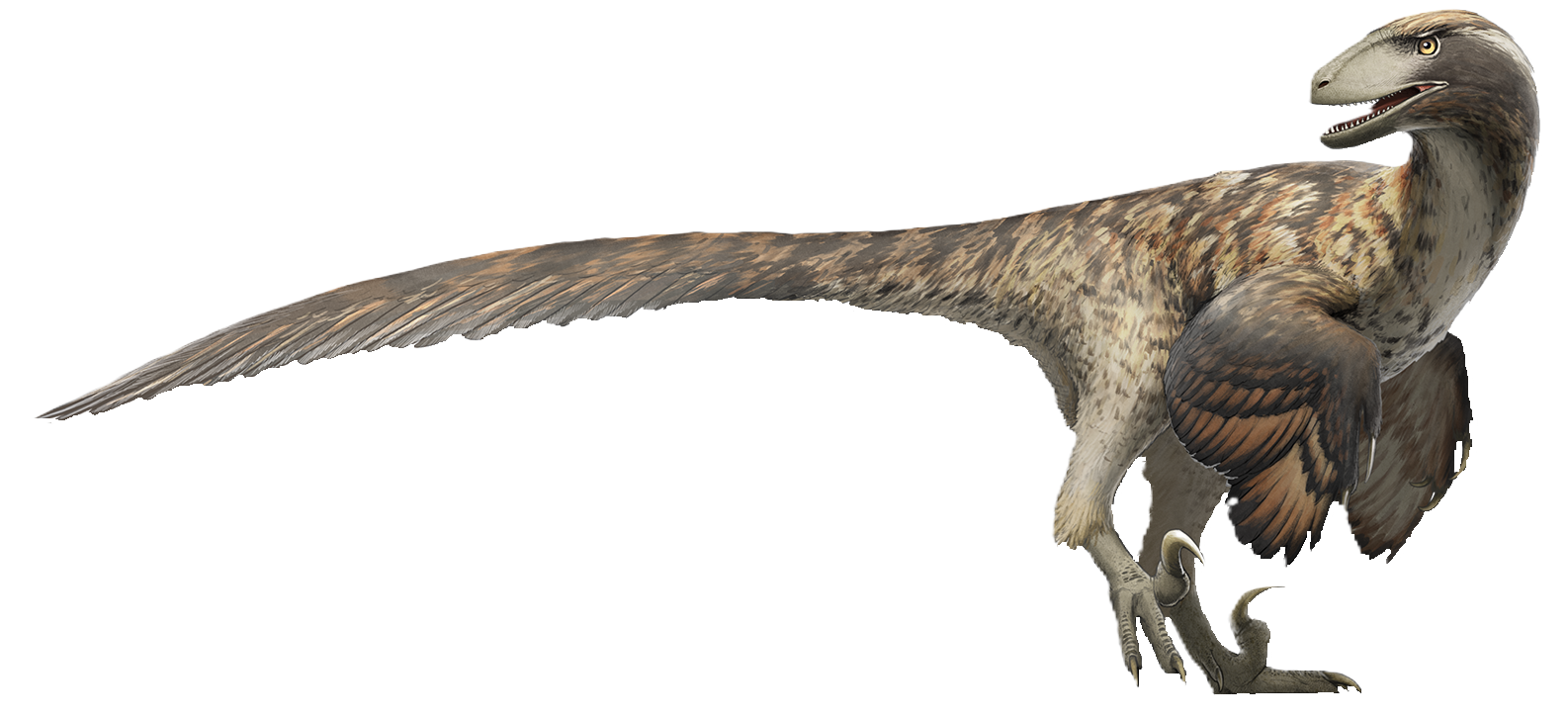
Deinonychus lived in Montana (USA), Wyoming (USA), Oklahoma (USA).
The fossil of Deinonychus has been found in North America in the states of Montana, Wyoming, and Oklahoma. The first fossils were found by palaeontologists Barnum Brown in 1931. The fossils were of great significance for science regarding understanding the evolution and movement of dinosaurs.
Taxonomy
Select a rank to explore where Deinonychus fits in the classification.