Deinocheirus mirificus
Discover fascinating Deinocheirus facts, including its enormous arms, massive claws, unusual hump-backed body, omnivorous diet, habitat and remarkable fossil discoveries in Late Cretaceous Mongolia
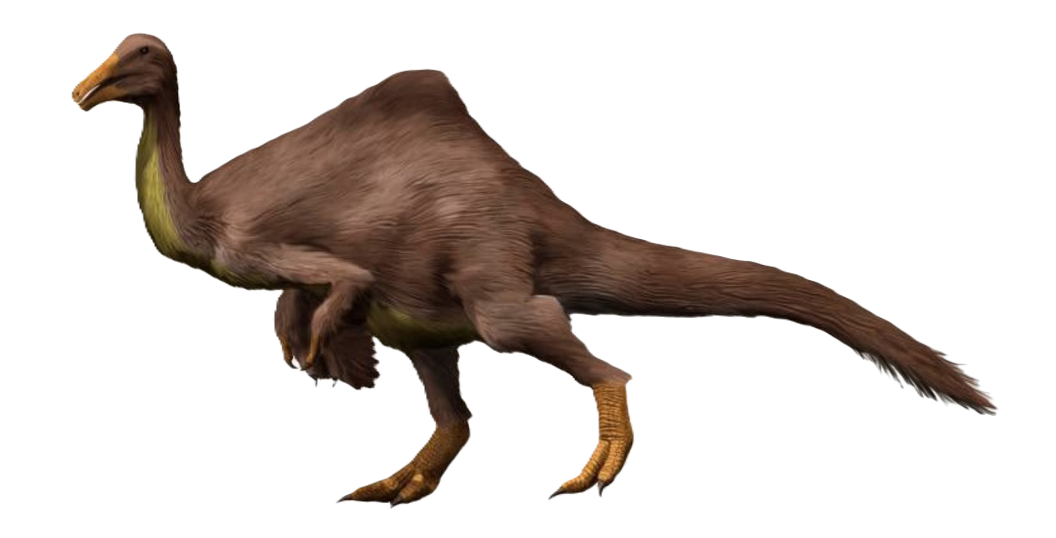
Deinocheirus was an enormous and unusual theropod dinosaur that lived in Mongolia during the Late Cretaceous Period, approximately 70 to 66 million years ago. Its name means “terrible hand,” referring to its enormous forelimbs and impressive claws. Unlike many other large theropods that were specialised meat-eaters, Deinocheirus was an omnivore that probably consumed a combination of plants and small animals. It measured approximately 10 to 11 metres in length and may have weighed around 6 tonnes. Its enormous body, broad shoulders, long neck and unusually tall back made it one of the most distinctive members of the ornithomimosaur group, a family of theropods that included several ostrich-like dinosaurs. However, unlike its more lightly built relatives, Deinocheirus had a massive body and powerful limbs that gave it a remarkably different appearance.
One of the most extraordinary features of Deinocheirus was its enormous forelimbs, which measured approximately 2.4 metres in length. Each hand had three long fingers ending in large, curved claws. These were among the largest known forelimbs of any theropod, although their exact function remains uncertain. They may have helped the dinosaur gather vegetation, pull down branches or handle food. Its skull was equally unusual, featuring an elongated snout and a broad, duck-like beak that was well suited to collecting food. Another striking characteristic was its tall, hump-like back, formed by extremely elongated neural spines extending upward from its vertebrae. These structures probably supported a substantial hump or other soft-tissue covering, although its precise appearance is unknown. Its tail also had an unusual structure, including several fused vertebrae near its tip, forming a feature known as a pygostyle.
For nearly five decades, Deinocheirus remained one of the greatest mysteries in dinosaur palaeontology. Its first fossil remains were discovered in 1965 by a Polish-Mongolian expedition in the Gobi Desert of Mongolia. The findings included enormous arms, shoulder blades and other skeletal elements, but the absence of a complete skeleton made it difficult to determine what the animal actually looked like. Palaeontologists Halszka Osmólska and Ewa Roniewicz formally named the species Deinocheirus mirificus in 1970. The mystery was largely resolved following the discovery of additional specimens in Mongolia in 2006 and 2009. These remarkably informative fossils revealed much more of its skeleton, including important details of its skull, back and hind limbs.
Deinocheirus inhabited ancient river systems and wetlands in Mongolia, where freshwater environments provided access to abundant vegetation and aquatic food sources. Its diet is particularly interesting because fossil evidence suggests that it consumed both plant material and aquatic animals. Scientists discovered more than a thousand gastroliths, or swallowed stones, in the abdominal region of a specimen. These stones probably helped grind food inside its digestive system. Preserved fish remains also provide evidence that aquatic animals formed part of its diet. It shared its environment with other remarkable dinosaurs, including the enormous predator Tarbosaurus. The discovery of its more complete remains transformed our understanding of ornithomimosaurs and revealed one of the most unusual giant theropods ever discovered.
Deinocheirus lived in Mongolia.
The fossils of Deinocheirus have been found in the Gobi Desert of Mongolia, especially in the Nemegt Formation. It has been identified through fossil evidence found by a Polish-Mongolian expedition in Altan Uul III in 1965. Until 2006, very little was known about the appearance of the dinosaur apart from its massive arms for nearly half a century.
Taxonomy
Select a rank to explore where Deinocheirus fits in the classification.