Cryolophosaurus ellioti
Discover fascinating Cryolophosaurus facts, including its size, appearance, unusual head crest, hunting lifestyle, fossil discoveries and life in Early Jurassic Antarctica
Cryolophosaurus was a large meat-eating dinosaur that lived in Antarctica during the Early Jurassic Period, approximately 194 to 188 million years ago. Its name means “frozen-crested lizard,” referring to its unusual head crest and the icy continent where its remains were discovered. It is estimated to have reached around 6 to 7 metres in length, although its exact size remains uncertain because only incomplete fossil remains have been recovered. This dinosaur had a powerful body, two strong hind legs and a long, muscular tail that helped it maintain balance while walking and running. It was a bipedal predator, meaning it moved primarily on two legs. Its discovery was particularly remarkable because it demonstrated that large carnivorous dinosaurs lived in Antarctica long before the continent became the extremely cold, ice-covered landscape we know today.
The most distinctive feature of Cryolophosaurus was its unusual bony crest, which extended sideways across the top of its skull, above the eyes. Unlike the elongated crests of some other dinosaurs, its crest formed a striking transverse structure that gave the animal a distinctive appearance. It was made primarily from bones associated with the skull, including the lacrimals, which form part of the region around the front of the eye sockets. The crest is one of the most recognisable features of this dinosaur and is responsible for its popular nickname, the Elvisaurus, because its shape resembles a swept-back hairstyle. Scientists have proposed several possible functions for this structure, including attracting potential mates, recognising members of the same species or displaying social status. However, its exact purpose remains uncertain. The crest was probably more important for visual display than for physical defence, as its delicate construction would have made it unsuitable for fighting.
The first known Cryolophosaurus fossils were discovered in 1991 by geologist David Elliot on Mount Kirkpatrick in the Transantarctic Mountains of Antarctica. Palaeontologist William Hammer and his research team subsequently excavated the remains during a scientific expedition. The dinosaur was formally named Cryolophosaurus ellioti in 1994, with its species name honouring Elliot for his contribution to the discovery. The original fossil material included a partially preserved skull and several bones from the rest of the skeleton. Although the remains were incomplete, they provided valuable information about the dinosaur's appearance, anatomy and evolutionary relationships. Further research and collecting efforts helped scientists understand this unusual predator more clearly. Its discovery was especially significant because Cryolophosaurus became one of the first large predatory dinosaurs described from Antarctica. Its fossils also provided important evidence that the continent supported a diverse dinosaur ecosystem during the Early Jurassic, when its climate was considerably warmer than it is today.
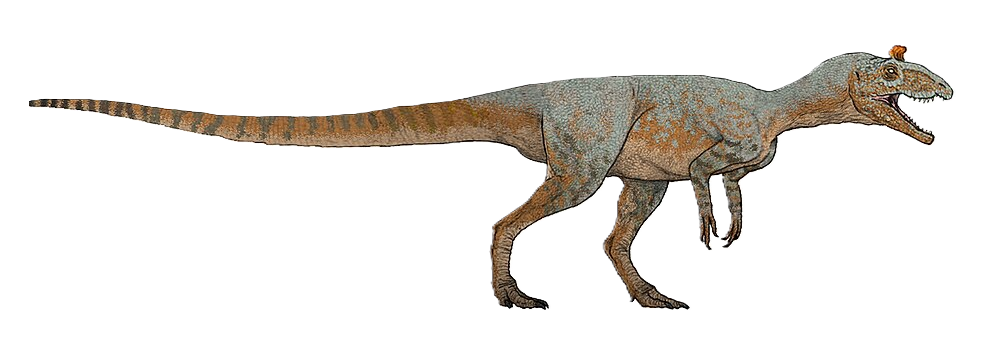
Cryolophosaurus lived in Transantarctic Mountains (Antartica).
The fossils of Cryolophosaurus were found at Mount Kirkpatrick in Transantarctic Mountains of Antarctica. They were found by geologist David Elliot on an expedition in 1991, and then removed by palaeontologist William Hammer and his team. This dinosaur was officially named in 1994. What made its discovery special was the fact that it was the first Antarctic non-avian dinosaur to be scientifically named.
Taxonomy
Select a rank to explore where Cryolophosaurus fits in the classification.