Coelophysis bauri
Explore fascinating Coelophysis facts, including its size, weight, sharp teeth, hunting habits, Late Triassic habitat and the remarkable discovery of more than 100 fossil skeletons at Ghost Ranch
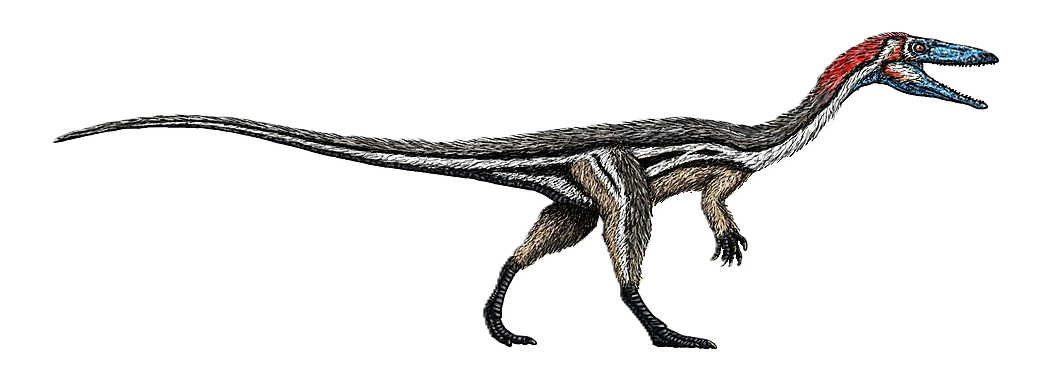
Coelophysis was a small, slender carnivorous dinosaur that lived in North America during the Late Triassic Period, approximately 225–201 million years ago. Its name means “hollow form”, referring to its lightweight, hollow limb bones. The best-known species is Coelophysis bauri. It measured around 2 metres in length and weighed approximately 20–30 kilograms, although estimates vary between individual specimens. Unlike the massive meat-eating dinosaurs that appeared later, Coelophysis had a remarkably lightweight body, a narrow skull, a long neck and an elongated tail. It walked on two powerful hind legs, which helped it move quickly and make sharp turns while pursuing prey. Its slender build, long legs and lightweight skeleton made it a well-adapted predator in the ecosystems of the Triassic Period.
One of the most distinctive features of Coelophysis was its narrow head, which contained numerous small, sharp and slightly curved teeth. These teeth were suited to gripping and tearing small prey rather than crushing hard food. Its diet probably included small reptiles, amphibians, insects and other small vertebrates that lived in its environment. Coelophysis had relatively short forelimbs compared with its hind legs, but its hands were equipped with three functional fingers ending in sharp claws. These may have helped it grasp and hold smaller animals while feeding. Its long, flexible tail played an important role in maintaining balance, particularly when running or changing direction. Another interesting adaptation was its hollow limb bones, which reduced the overall weight of its skeleton without sacrificing the strength needed for movement. Together, these features made Coelophysis an agile hunter capable of pursuing smaller animals across its habitat.
The first fossils attributed to Coelophysis were discovered in New Mexico in 1881 by fossil collector David Baldwin. American palaeontologist Edward Drinker Cope formally named and described the dinosaur in 1889. However, one of the most remarkable discoveries came in 1947, when a research team led by palaeontologist Edwin H. Colbert excavated an extensive fossil deposit at Ghost Ranch in New Mexico. The site contained more than a hundred Coelophysis skeletons, making it one of the most important early dinosaur fossil discoveries in North America. The remains included individuals of different sizes and ages, allowing researchers to investigate how the dinosaur developed as it grew. Some exceptionally preserved specimens also provided valuable information about its skeleton, body proportions and anatomy.
The enormous concentration of Coelophysis fossils at Ghost Ranch has raised interesting questions about how so many individuals ended up in the same location. Scientists have proposed several explanations, including seasonal gatherings around water sources or groups becoming trapped during flooding events. However, the precise circumstances surrounding their deaths remain uncertain. The discovery does not necessarily prove that Coelophysis lived in organised packs or hunted cooperatively. Nevertheless, the remarkable number of fossils has made this dinosaur an important subject for studying early theropods, their growth patterns and the development of carnivorous dinosaurs during the Late Triassic Period.
Coelophysis lived in USA, South Africa, Zimbabwe.
Coelophysis roamed on the territory of North America, namely the southwestern parts of the continent, such as New Mexico and Arizona. There have been a lot of interesting discoveries of this dinosaur. One of the most well-known fossil finds was made in Ghost Ranch, New Mexico, when in 1947 Edwin H. Colbert found several hundred skeletons of Coelophysis there.
Taxonomy
Select a rank to explore where Coelophysis fits in the classification.