Carnotaurus sastrei
Discover fascinating facts about Carnotaurus, including its size, distinctive horns, tiny arms, hunting abilities, fossil discovery and life in ancient Patagonia
Carnotaurus was a distinctive carnivorous dinosaur that lived in South America during the Late Cretaceous period, approximately 70 to 66 million years ago. Its name means “meat-eating bull,” referring to the two prominent horns above its eyes. The genus contains one recognized species, Carnotaurus sastrei, known from a remarkably informative fossil discovery in Argentina. This dinosaur measured approximately 8 metres long and may have weighed around 2 tonnes. Unlike some of the larger theropods of its time, Carnotaurus had a relatively lightweight body, a deep chest, powerful hind legs and a long, muscular tail. It walked on two legs, and its body proportions have led researchers to investigate its potential for rapid movement. However, its exact running speed remains uncertain because estimates must be based on fossil anatomy and biomechanical models rather than direct observations.
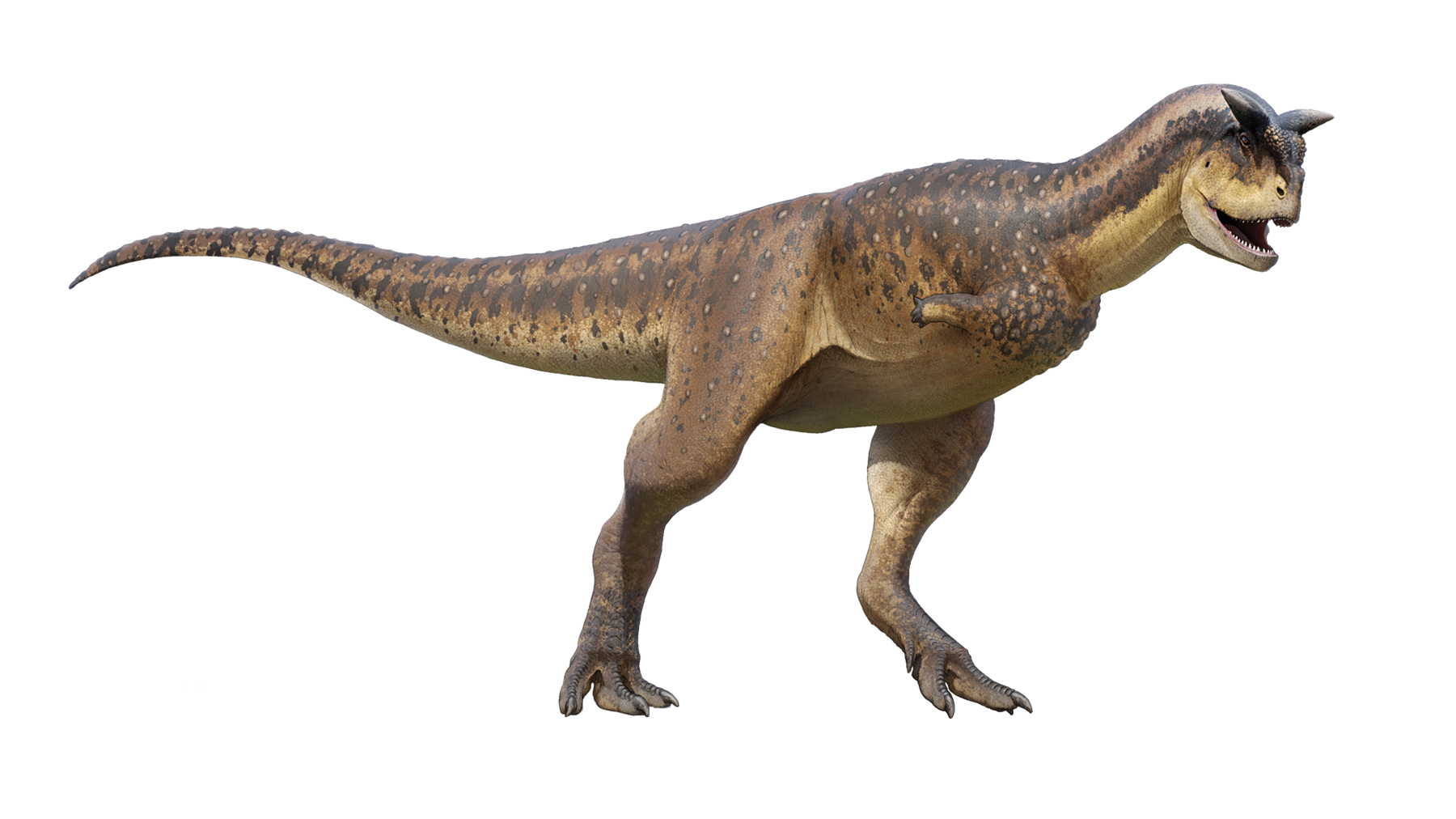
The most recognizable feature of Carnotaurus was its pair of thick, bony horns positioned above its eyes. These structures made its skull unusual among meat-eating dinosaurs and gave the animal its bull-like appearance. Their precise function is unknown, but scientists have proposed that they may have played a role in visual displays, competition or interactions between individuals of the same species. Its skull was relatively short and deep, with a narrow snout when viewed from the side. Another remarkable feature was its extremely reduced forelimbs. Even compared with the famously short arms of Tyrannosaurus rex, those of Carnotaurus were exceptionally small and had four digits, although their limited size suggests that they played little role in capturing prey. The dinosaur instead relied primarily on its powerful jaws, sharp teeth and muscular body when hunting. Its skull and jaw structure have attracted scientific interest because they may help explain how it captured and processed food. Fossilized skin impressions also reveal that its body was covered in scales, including larger, raised scales surrounded by smaller ones. These impressions provide valuable evidence of its external appearance.
The first known Carnotaurus skeleton was discovered in 1984 in Chubut Province, Patagonia, Argentina, during an expedition led by paleontologist José Bonaparte. Bonaparte formally described the dinosaur in 1985, establishing its importance in the study of South American theropods. The discovery was particularly significant because a substantial portion of the skeleton was preserved, along with impressions of the animal's skin. Such preservation is uncommon and offers researchers an opportunity to investigate both its skeletal anatomy and the texture of its outer body covering. The skin impressions provide direct evidence of scales in the preserved areas, rather than requiring scientists to reconstruct its appearance solely by comparing it with other dinosaurs. No confirmed evidence of feathers has been identified in the known specimen, although this does not conclusively establish that every part of its body was featherless. The absence of preserved feathers must be interpreted cautiously because fossilization rarely preserves every detail of an animal's body. As a result, some aspects of its skin covering remain uncertain.
Carnotaurus belongs to the Abelisauridae, a family of predatory dinosaurs that was especially prominent in the ancient southern continents. Its distinctive horns, reduced forelimbs, powerful hind legs and preserved skin make it one of the best-known members of this group. The combination of anatomical details and unusual fossil preservation has helped scientists investigate how abelisaurids moved, hunted and differed from other large carnivorous dinosaurs. Although many questions about its behaviour remain unanswered, Carnotaurus continues to provide important evidence about the diversity and evolution of predators in prehistoric South America.
Carnotaurus lived in Patagonia (Argentina).
Carnotaurus inhabited what is now Patagonia in southern Argentina, an area that supported diverse prehistoric ecosystems during the Late Cretaceous. Its environment included landscapes influenced by rivers, floodplains and seasonal changes in water availability. These habitats provided opportunities for large predators to hunt other animals, including plant-eating dinosaurs. The region's fossil deposits help researchers reconstruct the ancient communities in which Carnotaurus lived.
Taxonomy
Select a rank to explore where Carnotaurus fits in the classification.