Baryonyx walkeri
Discover Baryonyx walkeri, the unusual Early Cretaceous predator from England known for its enormous hooked claw, crocodile-like snout, fish-eating adaptations, and fascinating fossil discoveries
Baryonyx was a large carnivorous dinosaur that lived during the Early Cretaceous Period, approximately 130 to 125 million years ago. Its name means “heavy claw,” referring to the enormous curved claw on its hand, one of its most distinctive features. Its scientific name, Baryonyx walkeri, honours William Walker, the amateur fossil collector who discovered its remains. Baryonyx belonged to the theropod group and was a member of the spinosaurid family, which also included Spinosaurus and Suchomimus. It is estimated to have reached around 10 metres in length, with powerful hind limbs, strong forelimbs, an elongated tail, and a long, narrow skull. Unlike many large meat-eating dinosaurs, Baryonyx possessed a slender snout lined with numerous conical teeth, features well suited to catching slippery prey.
The discovery of Baryonyx took place in January 1983, when William Walker found a large claw-shaped fossil in a clay pit near Ockley in Surrey, England. Further excavation uncovered additional bones, and palaeontologists from the Natural History Museum in London recovered a remarkably informative partial skeleton. The species was formally described in 1986 by palaeontologists Alan Charig and Angela Milner. At the time, its remains represented one of the most complete skeletons of a large meat-eating dinosaur discovered in Britain. The fossil collection included much of the skull and numerous bones from the rest of the body, allowing researchers to investigate its anatomy in greater detail than was possible for many previously known spinosaurids. Its unusual combination of a long snout, specialised teeth, and powerful arms provided important evidence about the diversity of predatory dinosaurs during the Early Cretaceous.
Baryonyx probably obtained much of its food from aquatic environments, including rivers and wetlands. Its elongated jaws, conical teeth, and large hand claws suggest that fish formed an important part of its diet. The enormous claw on its first finger measured approximately 31 centimetres along its outer curve, making it a particularly striking feature of the animal. Researchers have proposed that this claw helped Baryonyx capture prey or handle animals near the water's edge. However, its diet was not necessarily restricted to fish. Fossil evidence associated with its remains includes fish bones and scales, as well as material attributed to a young plant-eating dinosaur, suggesting that it may also have consumed terrestrial prey. Its habitat supported a diverse community of animals, including crocodile relatives, turtles, fish, and other dinosaurs. Although its anatomy indicates an association with aquatic food sources, the precise ways in which Baryonyx hunted and moved through water remain uncertain.
Baryonyx is particularly important to palaeontology because its discovery greatly improved scientific understanding of spinosaurid dinosaurs. Before its skeleton was studied, relatively little was known about the anatomy and feeding adaptations of this unusual group. Its elongated skull and conical teeth helped researchers recognise characteristics associated with catching fish, while its robust forelimbs and enlarged claw raised questions about how it captured and handled prey. Comparisons with related dinosaurs, including Spinosaurus and Suchomimus, have also helped scientists investigate differences in their body structures, diets, and ecological adaptations. Although these dinosaurs shared several features, their anatomy indicates that spinosaurids were not all identical in form or lifestyle. Baryonyx is especially significant because its fossil evidence supports a varied diet that included fish and potentially other animals. Its remains continue to provide valuable information about predator diversity, feeding adaptations, and prehistoric ecosystems in Early Cretaceous Europe, and specimens displayed in museums help visitors explore this distinctive chapter of Britain's dinosaur history.
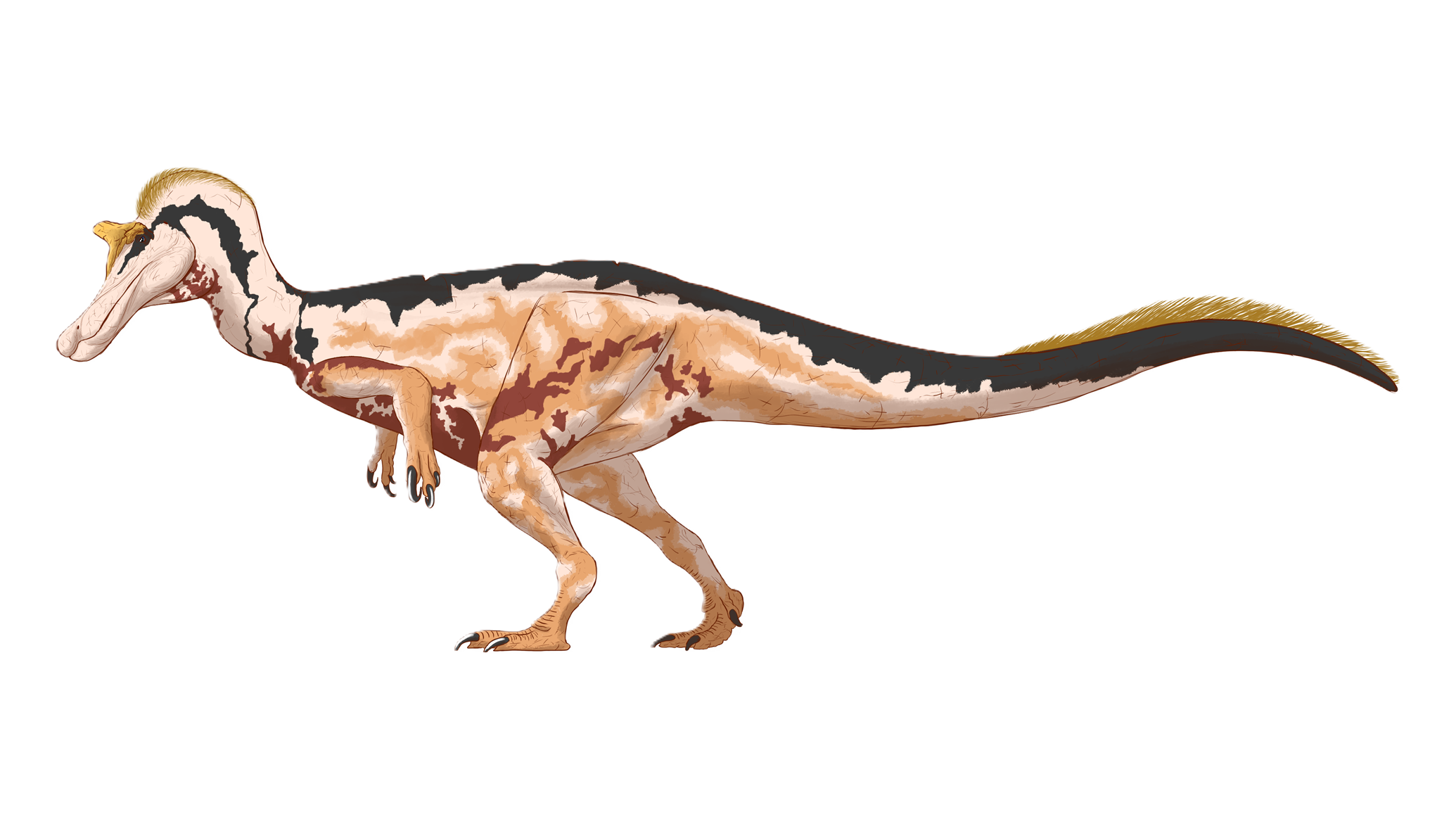
Baryonyx lived in England, Spain.
Baryonyx inhabited the region that is now southern England, which lay at a lower latitude during the Early Cretaceous than it does today. The surrounding landscape featured a warm climate and a mixture of coastal plains and low-lying terrain shaped by changing sea levels. These environments supported rich plant communities and diverse freshwater and coastal wildlife. Such conditions provided Baryonyx with access to aquatic prey and other animals living nearby.
Taxonomy
Select a rank to explore where Baryonyx fits in the classification.