Ankylosaurus magniventris
Discover Ankylosaurus’s Size, Diet, Habitat, Armor, Tail Club and Fossil History
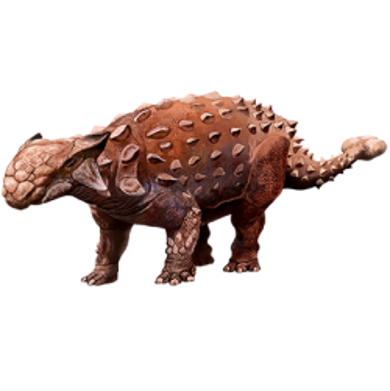
The Ankylosaurus was a heavily armoured, plant-eating dinosaur that lived approximately 68 to 66 million years ago during the Late Cretaceous period. Its name means “fused lizard,” referring to the strengthened and fused bones found in parts of its body. Belonging to a group of armoured dinosaurs called ankylosaurs, it could grow around 6 to 8 metres long and weigh several tonnes. Its broad, low-slung body was supported by four sturdy legs, while thick bony plates called osteoderms were embedded in its skin to provide protection. One of its most remarkable features was its powerful tail, which ended in a large bony club capable of delivering forceful blows. Its wide skull featured a beak suited to cropping plants, along with small teeth for processing vegetation. Although it was not a predator, Ankylosaurus was among the most heavily defended herbivorous dinosaurs of its time.
Ankylosaurus lived in western North America, particularly in areas that are now part of Montana, Wyoming and Alberta in Canada. Its fossils come from rocks dating to the final stages of the Cretaceous, when the region contained river systems, floodplains, forests and abundant plant life. This environment supported a diverse range of dinosaurs, including Triceratops, Edmontosaurus and the formidable Tyrannosaurus rex. As a herbivore, Ankylosaurus relied on vegetation rather than the animal prey hunted by carnivorous dinosaurs. Its low, broad body and sturdy limbs were well suited to moving across the ground while searching for food in its habitat.
The first Ankylosaurus fossils were discovered in Montana in 1906 during an expedition led by American palaeontologist Barnum Brown. The dinosaur was formally named and described in 1908. Despite its fame, its fossil record remains relatively incomplete compared with that of some other well-known dinosaurs. Scientists have recovered bones, armour plates, parts of the skull and tail clubs, but no complete skeleton has been found. As a result, researchers also compare its remains with those of related ankylosaurs to better understand its anatomy and likely biology. These comparisons help scientists reconstruct features that cannot be established from the available Ankylosaurus fossils alone.
Ankylosaurus fed on plants and low-growing vegetation, using its broad beak to crop leaves and other plant material. Its small teeth were suited to handling food, although it was not equipped for the extensive chewing seen in some modern plant-eating animals. Given its substantial body size, it would have needed a considerable amount of vegetation to meet its nutritional requirements. Its strong legs supported its heavy frame, while its body armour and tail club provided distinctive defensive adaptations. The arrangement of its bony plates varied across different parts of the body, offering protection in several areas. Research into its tail club suggests that it was capable of withstanding considerable forces, supporting the possibility that it could deliver powerful strikes. However, exactly how Ankylosaurus used its tail in encounters with predators remains uncertain. A large carnivore such as Tyrannosaurus rex may have posed a threat, making effective defence particularly valuable.
Ankylosaurus is important to palaeontologists because it demonstrates how herbivorous dinosaurs evolved specialised ways to protect themselves. Unlike many other plant-eating dinosaurs, it combined extensive body armour with a distinctive tail club, giving it an unusual defensive system. Studying its fossils helps researchers investigate the structure of its armour, the strength of its skeleton and the evolution of armoured dinosaurs. Comparisons with other ankylosaur species also reveal differences in their body structures and defensive features. Ankylosaurus lived near the end of the dinosaur era and disappeared around 66 million years ago during the mass extinction associated with a catastrophic asteroid impact. Although its behaviour remains largely unknown, its fossilised remains provide valuable evidence of how a large herbivore adapted to survive in a world filled with powerful predators.
Ankylosaurus lived in Montana (USA), Wyoming (USA).
The habitat of Ankylosaurus included western regions of North America, especially Montana, Wyoming, and Alberta of Canada. The Late Cretaceous environment was characterized by floodplains, forests, and rivers, all of which formed an ecosystem that supported plant-eating animals and predatory animals like T. rex, which coexisted with Ankylosaurus.
Taxonomy
Select a rank to explore where Ankylosaurus fits in the classification.