Amargasaurus cazaui
Discover fascinating Amargasaurus facts, including its size, herbivorous diet, Early Cretaceous habitat, fossil discoveries in Argentina, and the mysterious long spines that made this unusual sauropod stand out
Amargasaurus was a plant-eating sauropod dinosaur that lived approximately 129 to 122 million years ago during the Early Cretaceous Period. Its name means “La Amarga lizard,” referring to La Amarga, an area in Argentina where its fossils were discovered. It belonged to the dicraeosaurid family, a group of sauropods generally smaller and shorter-necked than many of their enormous relatives. Amargasaurus measured approximately 9 to 10 metres in length, although its exact weight remains uncertain because estimates depend on the available fossil evidence. Its most remarkable feature was a pair of elongated spines extending upward from the vertebrae along its neck and back. These unusual structures gave the dinosaur a distinctive appearance unlike that of many other long-necked herbivores. Scientists have proposed several explanations for their purpose, including supporting a skin-covered display structure or helping the animal communicate visually with others of its species. However, their precise function remains unknown, making Amargasaurus an especially intriguing subject for palaeontological research.
Amargasaurus lived in what is now Neuquén Province in Patagonia, Argentina. Its fossils were recovered from the La Amarga Formation, a geological unit containing rocks deposited during the Early Cretaceous. Argentine palaeontologists Leonardo Salgado and José Bonaparte formally described and named the dinosaur in 1991. This discovery expanded scientific understanding of the variety of sauropods that inhabited South America during the Cretaceous Period. The landscape of ancient Patagonia differed considerably from the region seen today, with river systems, floodplains, and areas of vegetation supporting diverse prehistoric animals. As a herbivore, Amargasaurus depended on available plant material and probably moved through its habitat while feeding on suitable vegetation. Its relatively short neck, compared with those of many other sauropods, may have influenced the plants and feeding heights it could reach. Although other plant-eating dinosaurs and carnivorous animals inhabited parts of prehistoric South America, the precise range of species living alongside Amargasaurus is not fully established. Fossils from the La Amarga Formation help researchers investigate the ancient environments, animal communities, and evolutionary history of dinosaurs in this part of the continent.
The most distinctive characteristic of Amargasaurus was its unusually long neck and back spines, which formed paired projections from certain vertebrae. These structures have attracted considerable scientific interest because they differ from the more familiar body shapes of many sauropods. One hypothesis suggests that the spines supported a covering of skin, potentially forming a raised structure along part of the neck and back. Another possibility is that they served as a visual display, helping individuals recognise one another or making the animal appear larger. However, neither explanation has been conclusively demonstrated. Because the available fossils do not preserve clear evidence of the original soft tissues surrounding the spines, scientists cannot determine their exact appearance or function with confidence. Their unusual form nevertheless offers valuable clues about the variety of anatomical adaptations that evolved among sauropods.
Amargasaurus fed on vegetation using teeth adapted for gathering plant material. Like other sauropods, it relied on its digestive system to process a substantial quantity of plant food to meet its nutritional needs. Its four-legged posture supported its body and allowed it to move while feeding across its habitat. Although it was considerably smaller than some of the giant sauropods, its sturdy body and distinctive neck made it a specialised member of this diverse dinosaur group.
Amargasaurus remains an important dinosaur for understanding sauropod evolution and the diversity of prehistoric life in South America. Comparisons with other dicraeosaurids help researchers examine relationships between related species and understand how sauropods varied in body size, neck proportions, and skeletal structure. Its fossils also contribute to the reconstruction of ancient Patagonian ecosystems and reveal how plant-eating dinosaurs adapted to their environments. Although the available remains cannot answer every question about its appearance or behaviour, they provide important evidence about its anatomy, diet, and evolutionary relationships.
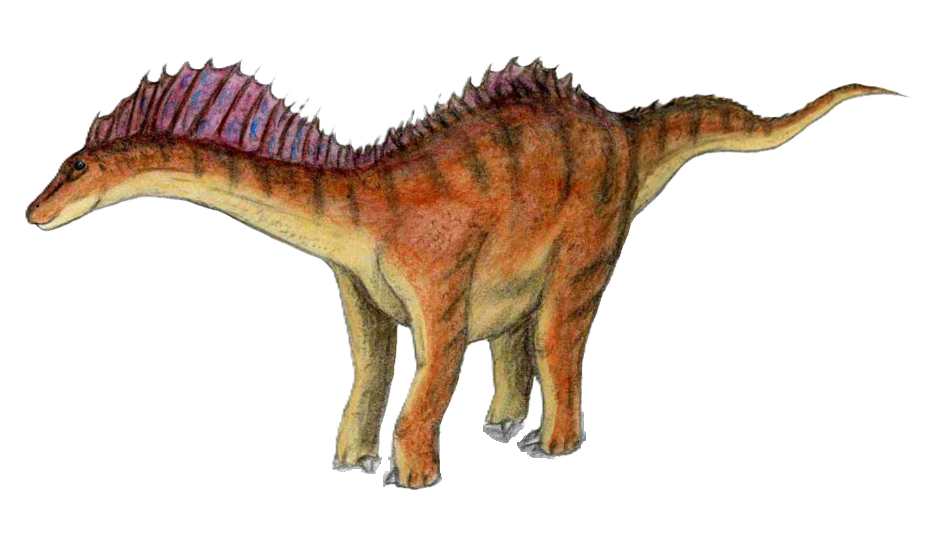
Amargasaurus lived in La Amarga Creek (Argentina).
Amargasaurus inhabited the ancient landscapes of South America, particularly the region that is now northern Patagonia in Argentina. Its surroundings included low-lying plains and river systems that supported plant growth and diverse prehistoric wildlife. The area offered feeding opportunities for this medium-sized sauropod, which relied on vegetation to survive. Fossils from this region help palaeontologists understand how dinosaurs adapted to the environments of Early Cretaceous South America.
Taxonomy
Select a rank to explore where Amargasaurus fits in the classification.